Does Birch Bark Harvesting Harm Trees? Separating Myth from Practice
Every spring, someone peels a strip of bark from a birch and someone else tells them they have just killed it. Both sides usually have half the story. A careless ring of cuts will indeed finish a tree, but a thin sheet lifted from the papery outer layers of a mature trunk is about as damaging as a good scratch. The gap between those two outcomes comes down to which layer the blade reaches, how much is taken, and when. Birch is more forgiving than its delicate looks suggest, and a good deal less forgiving than the internet's more casual advice implies.
What birch bark actually does
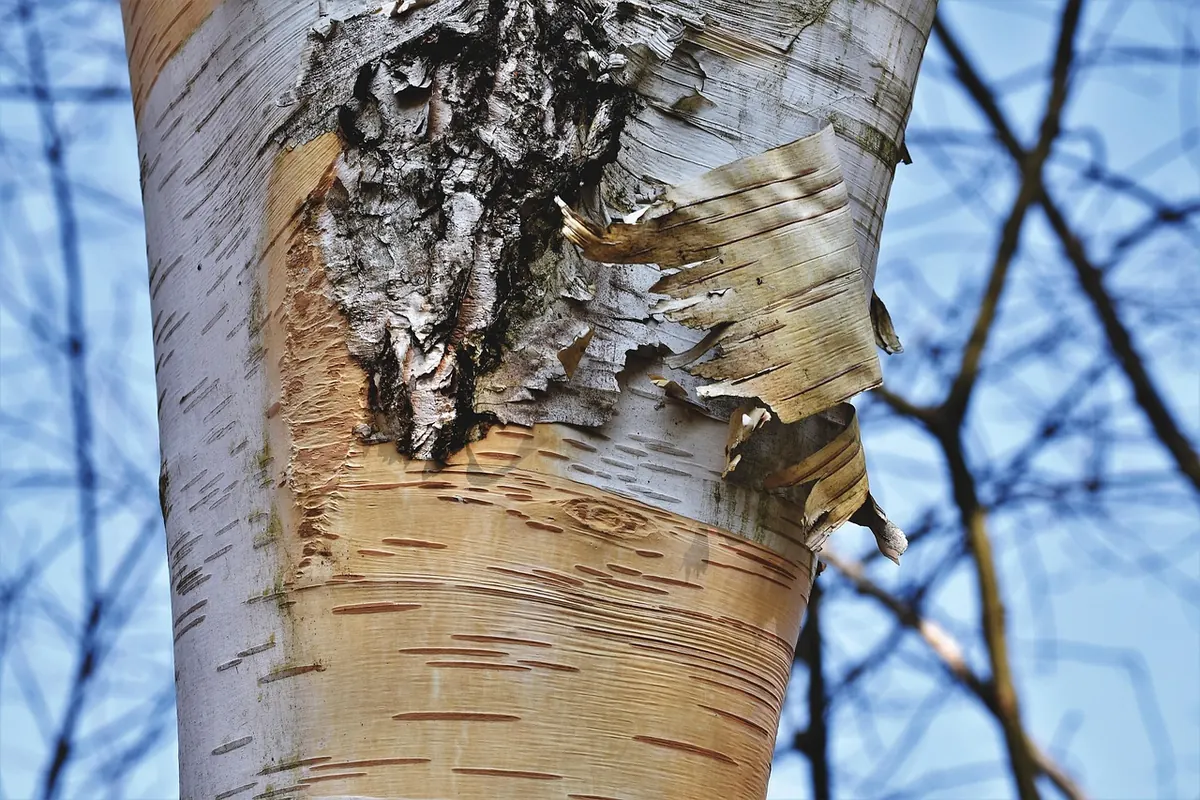
Birch bark is not one material but a stack of several. The white, peeling surface of a paper birch, or the silvery sheen of a silver birch, is dead tissue: cells packed with suberin and betulin, the substances that make the bark waterproof, reflective and remarkably resistant to rot. Functionally, it is a raincoat and a sunscreen.
The living work happens in a band only a millimetre or two thick underneath. There sits the phloem, which carries sugars down from the leaves, and the cambium, a layer of dividing cells that builds new wood inward and new bark outward. Every question about whether harvesting harms a tree is really a question about that thin band, and whether your knife has reached it.
Where the damage actually starts
Girdling
Remove a complete ring of bark and you cut the phloem all the way around the trunk. The leaves keep producing sugar, but the roots stop receiving any. The tree may leaf out once more on stored reserves and then decline. Ring-barking is used deliberately in forestry and land management to kill trees, precisely because it works on almost everything, birch included. It is not a harvesting technique. It is a method of killing.
Wounds that never quite close
Damage below the phloem is subtler. Birch does not seal wounds especially well. It is a pioneer species, quick to colonise open ground, quick to grow and, by tree standards, short-lived; it invests in height and speed rather than in armour. A large opening in the bark tends to stay visible for years, and exposed wood invites fungi that a healthier, better-defended tree would have held off.
Proportion matters as much as depth. A hand's-width strip on a trunk the width of your thigh is a minor injury. The same strip on a sapling barely past your knee is most of the tree's circumference and a serious setback.
What careful harvesting looks like
If you want bark and you want the tree to keep standing, work through this order.
- Start with wood that is already down. A storm-damaged birch, a trunk felled for firewood, a limb taken off while clearing a path. The bark is often loose, it is free, and the tree has already made its decision.
- Choose a tree you can afford to lose. If you must cut a standing birch, pick a mature one in a place where birch is common. Not the only birch on the street, not a planted ornamental, not the tree the whole garden is arranged around.
- Take a vertical strip, never a ring. Two parallel cuts down the trunk, then lift the sheet between them. The bark on either side keeps the phloem connected.
- Keep it narrow and short. A hand's width on a mature trunk, stopping well above the ground and well below the crown. Height buys you nothing and makes the wound harder to watch.
- Cut only the papery layers. Stop when the colour changes to the paler, slightly damp inner surface. If you find yourself levering the blade, you have gone too deep.
- Work one side only. Two strips on one trunk is not twice as safe. It is double the wound on the same plumbing.
- Leave the tree alone afterwards. No second harvest from that trunk for several years. A wound closing over is a better sign than one still open.
Why timing is a trade-off, not a rule
Bark separates most easily in late spring and early summer, when the cambium is actively dividing and the new cells are soft. Craftspeople prize that window because the sheets come away cleanly instead of tearing. It is also the season when the tree is spending most of its energy and moving the most sap, so the same window is the least convenient one for the birch.
Late summer and autumn are gentler in theory and worse in practice: a wound made in September has little time to seal before the cold. Midwinter gives brittle bark and stiff hands. A workable compromise, used by many who harvest regularly, is early summer after the leaves have fully expanded, so the tree has already built up reserves for the year. Whatever you choose, avoid harvesting in wet weather, when fresh cuts are most exposed to spores.
Limits worth respecting
- No rings, ever. There is no safe width for a complete circle.
- Skip young trees. Let them get through the vulnerable decades before anyone asks anything of them.
- Don't stack wounds. One strip per tree, and only on trees large enough for it to be small.
- Leave the best. Take from the abundant, spare the biggest, the oldest and the only one. A patch of birch that loses its largest trees loses its seed source.
- Be stricter on hard sites. Birches on thin, dry or exposed ground grow slowly and recover slowly. The same wound costs them far more.
- Leave standing dead wood alone if it has holes or cavities. It is someone's home.
- Treat protected sites as off-limits. Reserves, parks and scheduled sites almost always prohibit it, and for good reason.
Rules, permits and permissions
Ownership comes first. On private land, you need the owner's permission, whether that is a neighbour, a farmer or a company. On public land the rules vary from country to country and often from site to site. In Italy, forest use is regulated largely at regional level, and inside parks and protected areas the park authority's own rules sit on top. Elsewhere the pattern is similar: felling licences and tree protection orders in the UK, forest-product permits on many public lands in North America, and blanket bans in nature reserves nearly everywhere.
A permit someone obtained in another region, or a supplier's licence to buy bark, does not transfer to you. None of this is legal advice, and it is not meant to be: regulations change, and the only reliable answer comes from the landowner and the local forestry office. One phone call costs less than a fine, and considerably less than an afternoon spent explaining yourself.
Before you peel: a five-minute check
Stand in front of the tree and answer these honestly.
- Is this birch already down, or does it need to stay standing?
- Is the trunk big enough that a strip would be a small fraction of it?
- Am I cutting two lines down the trunk, or drifting into a ring?
- Is this my land, or do I hold clear permission?
- Is the season sensible, and is the weather dry?
- Do I actually need this much bark, or just a little?
Most of the birch bark in circulation comes from trees felled for timber, firewood or land clearing, and that is the supply worth seeking out first. Harvesting from a living birch can be done well, and there are people who have done it carefully for decades. It simply asks for patience, a shallow blade and a willingness to take less than you could. The tree is rarely the problem. Hurry is.
Photo: Ralphs_Fotos / Pixabay